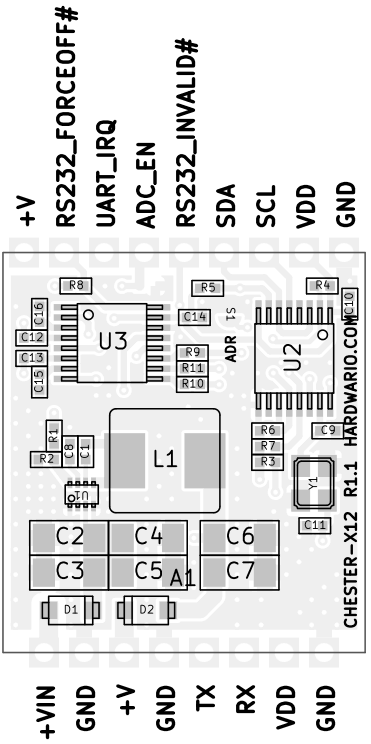
CHESTER-X12
The CHESTER-X12 is an RS-232 serial-communication extension module for the CHESTER platform.

Module Overview
CHESTER-X12 provides an RS-232 serial interface. An SC16IS740IPW I²C-to-UART bridge connects to the CHESTER mainboard over I²C, and a MAX3226EEUE+ transceiver converts the UART signals to true RS-232 levels with ±15 kV ESD protection. The RS-232 transmit and receive lines are brought out to the terminal block.
The module can run directly from the CHESTER mainboard. Alternatively, an external 5–28 VDC line on +VIN feeds the on-board TPS62933 step-down converter, whose fixed 5 V output (+V) powers the CHESTER mainboard. Schottky diodes (PMEG6010ELR) protect the input. An on-board TLA2021 ADC, read over I²C, monitors the input voltage.
Key Features
- RS-232 Interface: Full-duplex serial with true RS-232 levels and ±15 kV ESD protection on the I/O pins (MAX3226EEUE+).
- I²C-to-UART Bridge: SC16IS740IPW bridges the RS-232 UART to the CHESTER mainboard's I²C bus.
- Flexible Power: Runs from the CHESTER mainboard, or from an optional 5–28 VDC line on +VIN via the on-board TPS62933 step-down.
- Input Protection: Schottky diodes (PMEG6010ELR) on the power input.
- Input-Voltage Monitoring: On-board I²C ADC (TLA2021) measures the input voltage.
- Low-Power Control: The RS-232 transceiver can be placed in shutdown via FORCEOFF# for low-power operation.
Typical Applications
- Industrial Sensors: Connection to sensors and controllers through the CHESTER platform.
- Legacy Equipment: Integration with existing RS-232 devices.
- Building Automation: HVAC systems, lighting control, and metering.
- Commercial: Point-of-Sale (POS) terminals and barcode scanners.
- Utilities: Serial console access and laboratory equipment interfaces.
Technical Specifications
| Parameter | Value |
|---|---|
| Interface Type | RS-232 |
| Protocol | Full-duplex asynchronous serial |
| Baud Rate | Up to 250 kbps (transceiver limit) / 3 Mbps (bridge limit) |
| Data Bits | 5, 6, 7, 8 |
| Stop Bits | 1, 1.5, 2 |
| Parity | None, Even, Odd, Mark, Space |
| Flow Control | Software (XON/XOFF) |
| Host Interface | I²C |
| Power Input (+VIN) | 5–28 VDC (optional external supply) |
| Power Output (+V) | Fixed 5 V, powers the CHESTER mainboard |
| Voltage Monitoring | On-board 12-bit I²C ADC (TLA2021), measures the input voltage |
| Board Interface | Castellated holes on two opposite edges, soldered to the CHESTER mainboard |
| Hardware Revision | R1.2 |
Key Components
| Component | Part Number | Description |
|---|---|---|
| I²C-to-UART Bridge | SC16IS740IPW | Single UART with I²C interface, 64-byte FIFO |
| RS-232 Transceiver | MAX3226EEUE+ | True RS-232 levels, ±15 kV ESD protection |
| Voltage-Monitoring ADC | TLA2021 | 12-bit I²C ADC (address 0x49); measures the input voltage |
| DC-DC Converter | TPS62933 | Step-down converter, 5–28 VDC input, 5 V output |
| Input Protection | PMEG6010ELR | Schottky barrier diodes for input protection |
Pin Configuration
The module uses a standardized header layout compatible with CHESTER extension slots.
The pin configuration shown is for the CHESTER-M CGLS mainboard.
CHESTER-X12 Connector Pinout
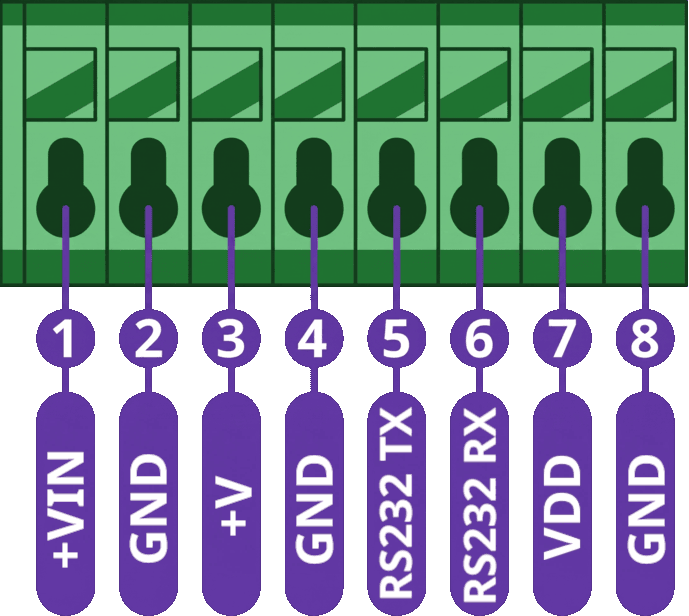
| Pin | Signal | Type | Description |
|---|---|---|---|
| 1 | +VIN | Power Input | Optional external DC input to the on-board step-down (5–28 VDC) |
| 2 | GND | Ground | System ground reference |
| 3 | +V | Power Output | Fixed 5 V from the on-board step-down (powers the CHESTER mainboard) |
| 4 | GND | Ground | System ground reference |
| 5 | RS232 TX | RS-232 | RS-232 transmit data (module output) |
| 6 | RS232 RX | RS-232 | RS-232 receive data (module input) |
| 7 | VDD | Power | 3.3 V logic supply from the CHESTER mainboard |
| 8 | GND | Ground | System ground reference |
The module can run directly from the CHESTER mainboard. When an external 5–28 VDC supply is connected to +VIN (Pin 1), the on-board TPS62933 step-down converter produces a fixed 5 V on +V (Pin 3), which powers the CHESTER mainboard.
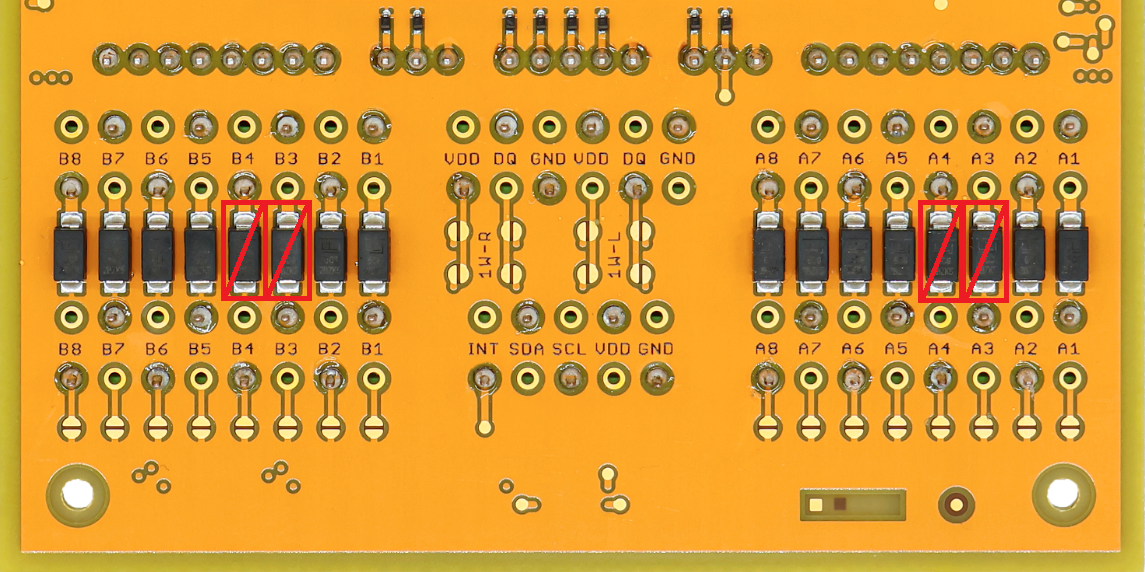
The RS-232 transceiver uses negative voltage levels. CHESTER must have modified ESD protection on inputs for signals A3 and A4 on slot A, or B3 and B4 on slot B. The standard unidirectional TVS diodes (SMA6J28A) must be replaced with bidirectional ones (SMA6J28CA). If ESD protection is not required, these diodes can be removed.
Host Interface (I²C)
CHESTER-X12 communicates with the CHESTER mainboard over the standard I²C bus. Two devices sit on the bus: the SC16IS740IPW UART bridge and a TLA2021 voltage-monitoring ADC.
The UART bridge address is selected by the on-board solder bridge S1 (silkscreen ADR): 0x54 in slot A and 0x55 in slot B. When the module is supplied as part of a complete CHESTER unit, this address is set at the factory; a standalone module must have its address set by the user. The TLA2021 ADC sits at address 0x49.
Besides SDA/SCL, the module uses the slot's GP pins:
| CHESTER-X pin | Signal | Source / function |
|---|---|---|
| GP0 / A0 | INVALID# | MAX3226EEUE+ — RS-232 receiver level-valid indicator |
| GP1 / A1 | ADC_EN | Enables the TLA2021 input-voltage measurement |
| GP2 / A2 | IRQ | SC16IS740IPW UART interrupt |
| GP3 / A3 | FORCEOFF# | MAX3226EEUE+ shutdown (low-power) control |
The transceiver's FORCEON input is tied high, so firmware can place the RS-232 transceiver into a low-power shutdown state by asserting FORCEOFF# (GP3/A3).
RS-232 Connection
Wire the serial device to the terminal block: RS232 TX (Pin 5), RS232 RX (Pin 6), and a common GND (Pin 2, 4, or 8). Only the transmit and receive data lines are brought out — no hardware handshaking (RTS/CTS) lines are available on the connector.
The RS-232 interface is not galvanically isolated, so the serial device and the CHESTER node must share a common ground reference.
Enclosure Feed-Through
Two options bring the serial cable into the enclosure:
- Cable gland (default): route the RS-232 conductors through a cable gland in the enclosure wall and wire them to the terminal block.
- Panel-mount connector (on request): an external connector in the enclosure wall lets the user plug in the serial cable, with no loose wiring inside. Available on request.
Compatible CHESTER Configurations
The CHESTER-X12 module can be used with various CHESTER mainboard configurations. Below are examples of compatible setups:
CHESTER-M (CGLS)
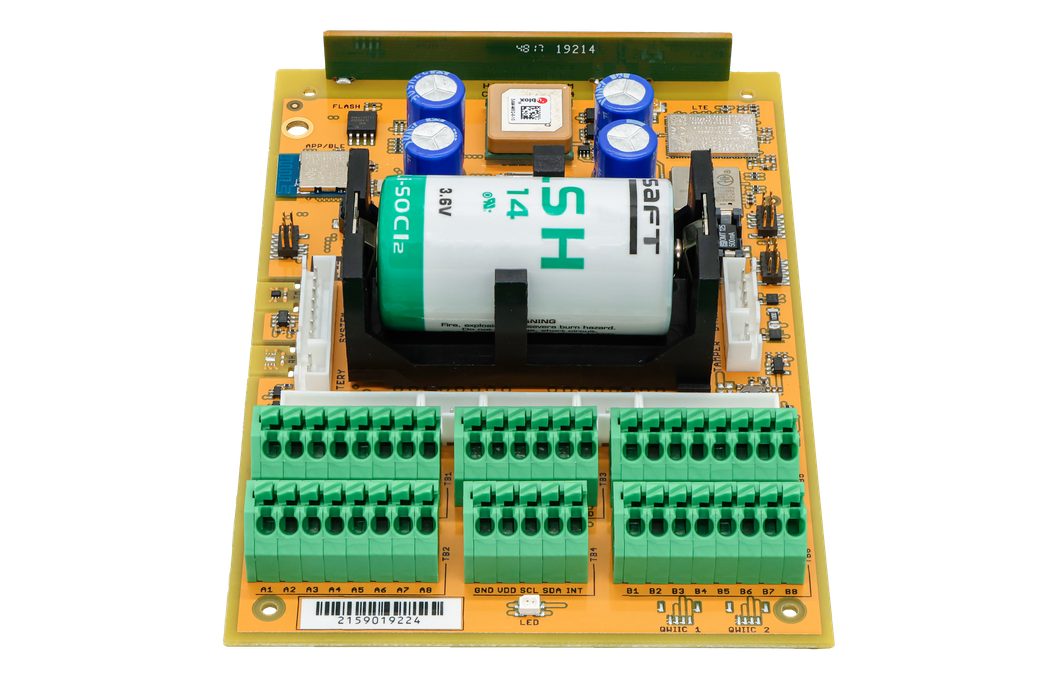
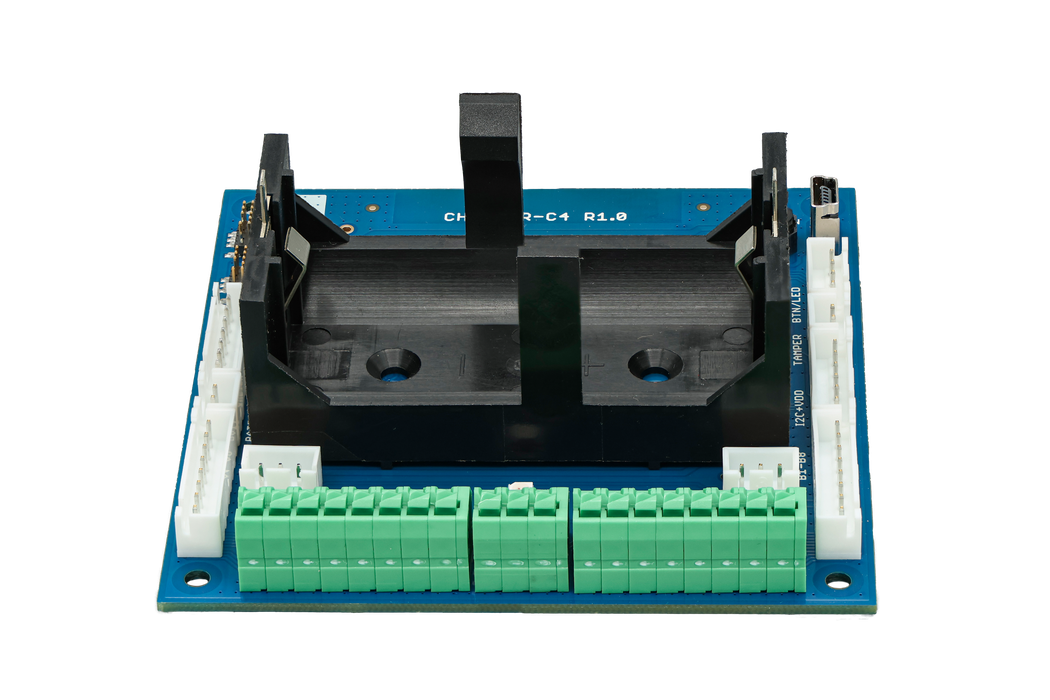
CHESTER-C4
CHESTER SDK usage
CHESTER-X12 can be used as part of the CHESTER SDK using the ctr_x12_a and ctr_x12_b shields, or hardware-chester-x12-a and hardware-chester-x12-b Project Generator features.
Schematic Diagrams
The complete schematic — covering the main page, the interface, and the power supply — is available as a PDF:
Module Drawing