MACHINE PROBE (v1.3)
MACHINE PROBE is an external measurement probe designed to be mounted directly on the monitored equipment. A single enclosure integrates a set of digital sensors (temperature, humidity, accelerometer, ambient light, Hall sensor) that communicate over an internal I²C bus. A 1-Wire-to-I²C bridge exposes the whole probe over a single 1-Wire data line, so from the perspective of STICKER Input the probe behaves as one device connected with a three-wire cable.
The MACHINE PROBE is not limited to STICKER Input — it is also fully compatible with HARDWARIO CHESTER, which exposes the same 1-Wire interface. The same probe can therefore be reused across both platforms without any hardware modification.
Description and real-world use
The probe has already proven itself in the field — for example monitoring shakers in the ProXimos project, where it reliably:
- measures the temperature of the monitored equipment,
- measures the relative humidity of the surroundings,
- detects motion, shock and vibration using its accelerometer.
By combining these quantities you can monitor not only the operating conditions but also the actual operation of the machine — for instance recognizing whether the equipment is genuinely running, has stopped, or is vibrating abnormally.
Example: monitoring motor vibration
A typical use case is vibration monitoring of electric motors, pumps and fans. The MACHINE PROBE is mounted directly on the motor housing, and its built-in accelerometer continuously senses mechanical vibration. From the measured data you can:
- confirm whether the motor is running or stopped (presence and level of vibration),
- detect a gradual increase in vibration that often precedes a mechanical fault — worn bearings, shaft misalignment or an unbalanced load,
- combine the vibration reading with the probe's temperature measurement to catch overheating that develops alongside excessive vibration.
This makes the probe a simple building block for predictive maintenance: instead of waiting for a motor to fail, the trend in vibration and temperature is sent over LoRaWAN and an alert can be raised before a breakdown occurs.
Electrical specifications
| Parameter | Value |
|---|---|
| Supply voltage range | 3.0 – 5.5 V |
| Reverse-polarity protection | Yes (integrated) |
| Sensor bus | I²C (internal), exposed via 1-Wire bridge |
| Connection | Three-wire interconnecting cable |
The integrated reverse-polarity protection guards the probe electronics against incorrect wiring of the supply leads. Even so, we recommend following the correct wire order from the table below during installation.
Wiring
The probe connects with a three-wire cable using the following pinout:
| Wire | Signal | Description |
|---|---|---|
| Minus | GND | Ground / common |
| Data | DATA | 1-Wire data bus |
| Plus | VDD | Supply 3.0 – 5.5 V |
Onboard sensors and chips
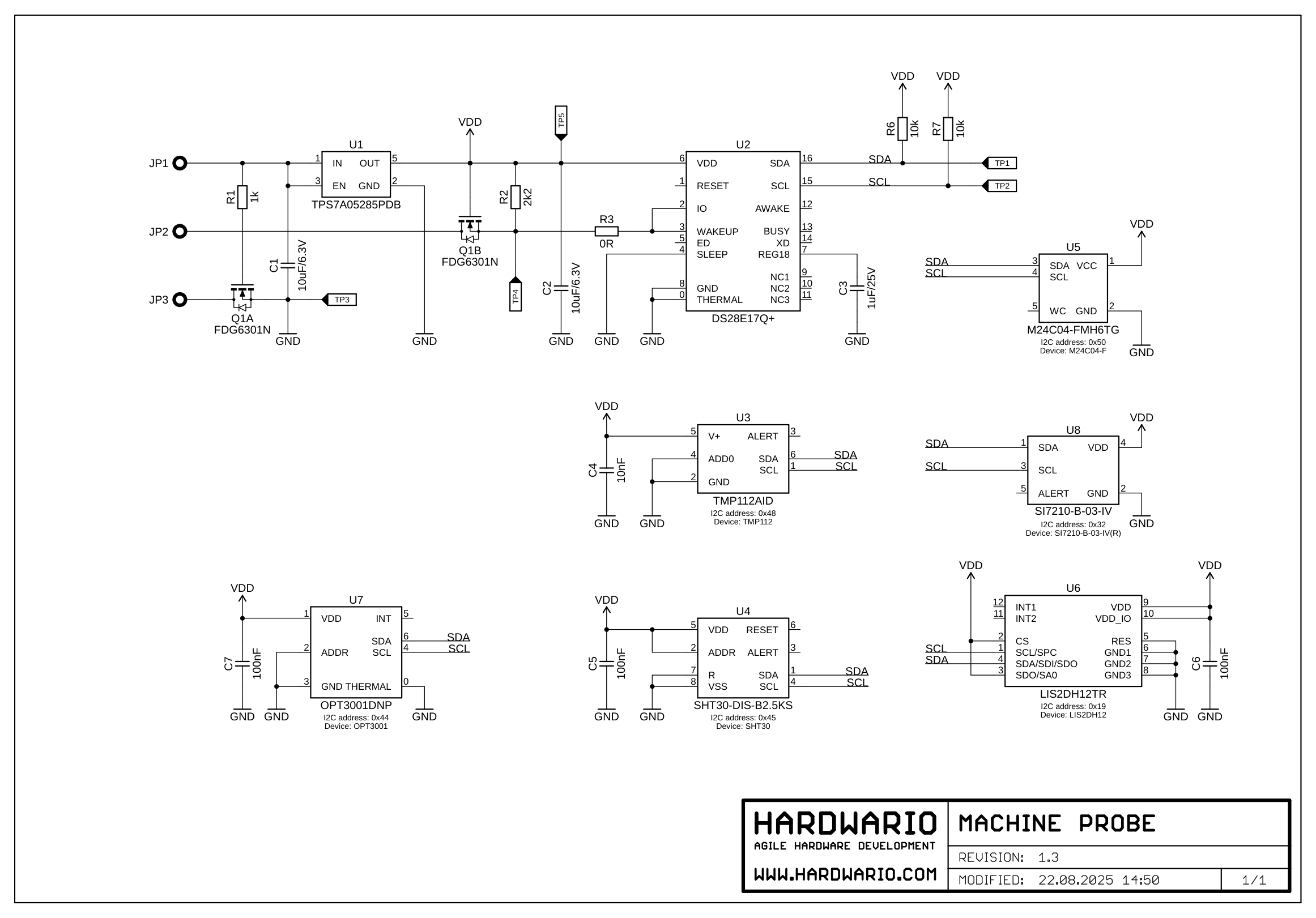
The following table summarizes the active components fitted on the MACHINE PROBE R1.3 board, including their function and I²C address.
| Reference | Chip | Function | I²C address |
|---|---|---|---|
| U2 | DS28E17Q+ | 1-Wire → I²C bridge (handles all probe communication) | — |
| U4 | SHT30-DIS-B2.5KS | Temperature and humidity sensor | 0x45 |
| U6 | LIS2DH12TR | Accelerometer / motion sensor | 0x19 |
| U3 | TMP112AID | Digital temperature sensor | 0x48 |
| U7 | OPT3001DNP | Digital ambient light sensor | 0x44 |
| U8 | SI7210-B-03-IV | Hall sensor / magnetometer | 0x32 |
| U5 | M24C04-FMH6TG | EEPROM memory | 0x50 |
| U1 | TPS7A05285PDB | Linear regulator (LDO) | — |
The DS28E17Q+ (U2) acts as a bridge between the 1-Wire bus (toward STICKER Input) and the internal I²C bus that connects all of the probe's sensors. The I²C addresses therefore apply within the probe's internal bus, not directly on the STICKER Input interface.
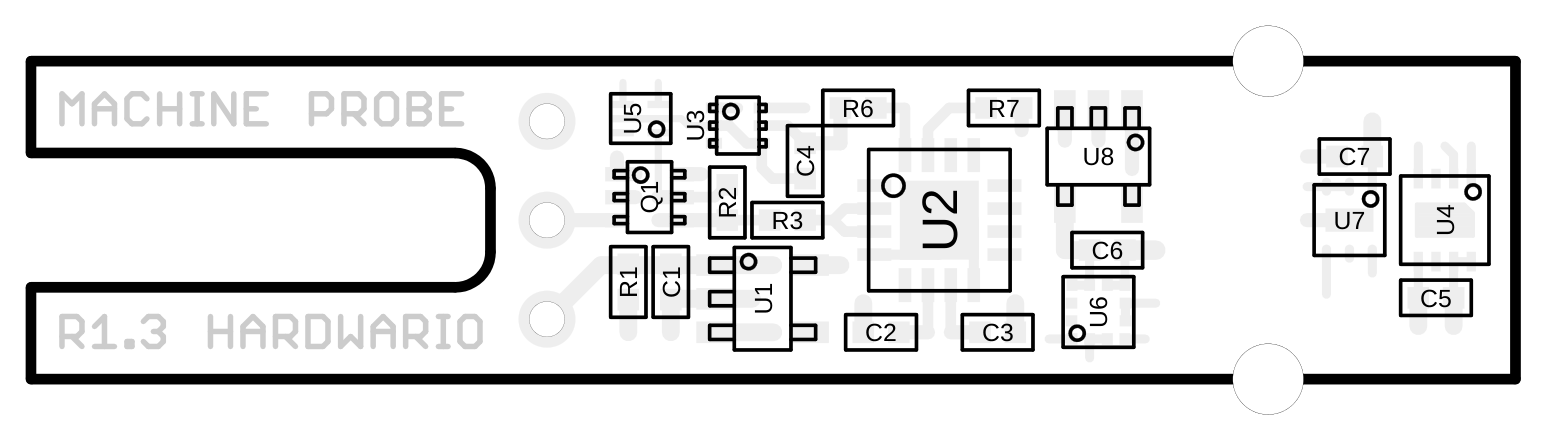
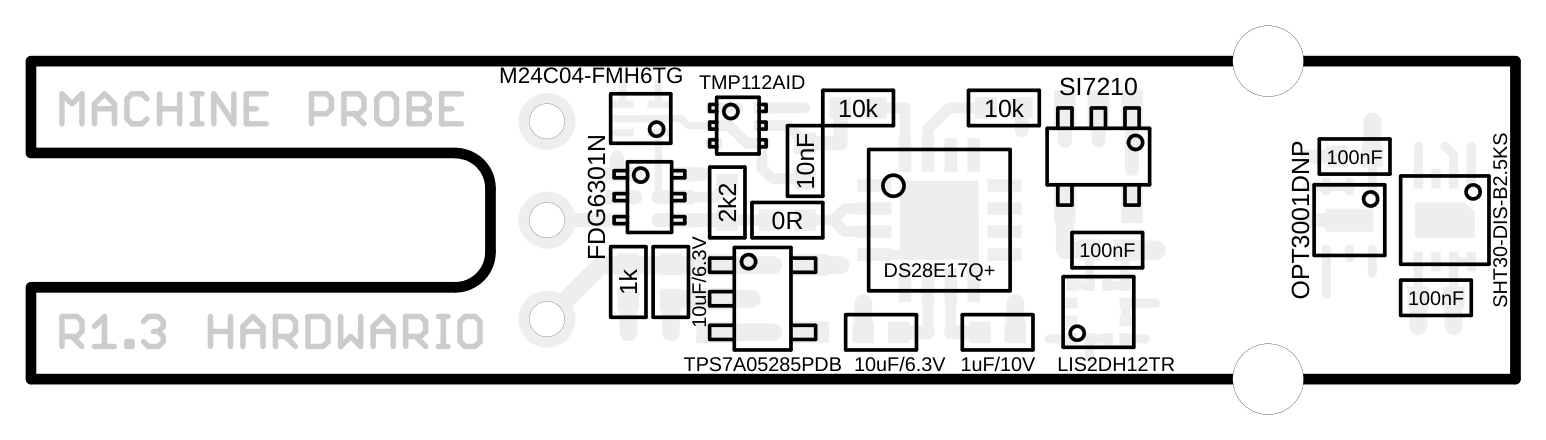
Board assembly
Component reference designators (top side):
Component values (top side):
Show schematic (MACHINE PROBE R1.3)